
The Problem

Every flight departs with unsold seats — not because demand doesn’t exist, but because there is no mechanism to capture it before departure.
Discounting fills seats, but erodes yield. Doing nothing protects pricing but leaves revenue unrealized
The Opportunity
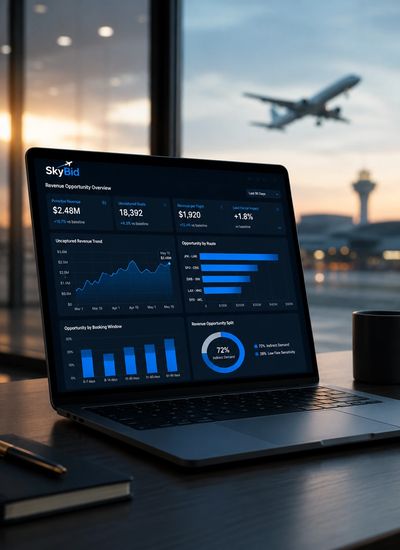
Airlines leave revenue behind on every flight
Even at high efficiency levels, flights routinely depart with unsold seats — a form of perishable inventory that cannot be recovered once the aircraft leaves.
Small improvements create meaningful revenue
Industry research shows that even 1–2% improvements in pricing or demand capture can translate into significant revenue gains at scale.
For airlines operating on thin margins, this is not marginal — it’s material.
Margins are too tight to ignore unused capacity
- Global airline profit is roughly $7–8 per passenger
- In some regions, it drops to near $1 per passenger
Every additional filled seat directly impacts profitability
The industry is already shifting
- Ancillary revenue is projected to exceed $150B globally
- Some airlines generate 50%+ of revenue from non-ticket sources
The model is already there — this extends it to base inventory
What this means
A controlled increase in load factor can:
- Generate incremental revenue from existing flights
- Improve performance on low-demand routes
- Do so without changing fare structures or discounting publicly
Built on industry research
This SkyBid concept is grounded in market validation survey data, along with analysis and research from organizations including IATA, MIT, McKinsey, and industry revenue management studies.
The Approach

Why It Works

Hidden Demand
Revenue Stability
Hidden Demand
Captures demand beyond published fares without lowering them, capturing price-sensitive demand that would otherwise not convert.
Load Factor
Revenue Stability
Hidden Demand
Improves load factor on low-demand routes, generating incremental revenue on seats that are projected to fly unfilled.
Revenue Stability
Revenue Stability
Revenue Stability
Stabilizes revenue earlier in the booking cycle, between 30-90 days before the scheduled departure